Maybe this reflection has been motivated by the man himself reaching 100 years of age, and not physically diminished like Jimmy Carter—or anyone who meets that mighty milestone with no idea of who they are or what there is to celebrate. More like Australian actor Vince Ball, who at 102, spent more than half a century acting. Or, as Wikipedia volunteers note:
“Vincent Martin Ball, OAM (born 4 December 1923) is an Australian retired actor of film, theatre and radio active in the industry for nearly 55 years…”
Read aloud, “radio active” would be heard as a compound word, which detectably, we all are. Millions of people exceed fifty-five years of that (including Dick Van Dyke), without being mentioned in Wikipedia at all.
It would be useful for this free, online encyclopaedia to value the significance of properly placed commas. As a card-carrying fan of the much-maligned Oxford one, there are decidedly too few commas in the world. It’s no wonder we don’t understand each other anymore.
Cultural Curiosities
A long, long time ago (this is insanely brilliant) Richard Ayoade directed Vampire Weekend’s music video Oxford Comma. It’s a nice touch of almost-useless information to have. He has also directed Arctic Monkeys, Kasabian, and Yeah Yeah Yeahs, even though he’ll always be Moss from The IT Crowd to me—and no doubt to many others.
2025 has been called a “hinge year” by some. “Unhinged year” would be markedly more apt, but apparently we’re all too delicate for reality now. With unalived as one of the stupidest words in modern usage, along with lists of words and phrases that have apparently been “cancelled,” it’s always the Gulf of Mexico to me.
This hinge year gave us glimpses of a new inhumane order that really isn’t so new. We’ve been unstoppably slipping down an icy slope of heartlessness and brutality since at least the Twin Towers. Grief is advertised, monetised, and franchised; scapegoat hunting is an international media sport. Weaponising fear has created more wedges in society than the national sum total served with sour cream and sweet chilli sauce in an Aussie pub. It’s a lot to deal with. And most of us can’t.
History Lessons
Putting aside Plato and Aristotle (respectfully; you can’t just elbow those cerebral giants out of the way), staying informed of world events has been considered a virtue since at least the Age of Enlightenment. Being well-versed in the goings-on of the world at large in the 17th century made perfect sense—it was literally the size of a planet, with the means of communication unaltered by even the telegraph. News and information were fairly contained and finite.
The devastating 1815 eruption of Mount Tambora was barely reported in Europe, being on the narrow peninsular of Sumbawa, in the far-off lands of the then Dutch East Indies. It was the biggest volcanic activity in the history of humankind, ten times the volume of Krakatau (if Krakatoa’s on the banned list). About 128 billion tonnes of pyroclastic material blasted into the atmosphere. It immediately wiped out the local inhabitants, along with the entire Tambora language.
The “year without summer” followed, with disease and years-long famine in North America, western China, and Europe. The dreadful weather in Geneva inspired 18-year-old Mary Wollstonecraft Godwin to go all gothic and pen Frankenstein; or, The Modern Prometheus, publishing anonymously until putting her Shelley name to it thirteen years later.
A whole lot of important and remarkable stuff went on then that very few knew about. Now, a whole lot of absolutely unimportant and completely unremarkable stuff goes on every second of the day—and almost everybody knows about it.
Two tossers kiss-cammed at a Coldplay concert had social media shock waves reverberate the earth dwarfing Krakatau to a discreet burp, and mainstream news reported it. Five months later, one of the participants started giving interviews. Why anyone would revive something that should never have been given breath in the first place is anyone’s guess.
Privacy, Social Norms, and the Modern Age
How is being an unwilling witness to the unvirtuous, a virtue? Who decided on the wholesale piracy of privacy? When there’s rectitude in looking like a dead person while you’re still alive, is it even worth asking anymore?
It’s creepy. Fourteenth-century skeletons like this would have been accompanied by the Black Plague—not Black Amex. Socially they’d been shunned, not hashtagged. (Or more correctly, “hatch”-tagged—and therein lies the sloppiness we embrace.)
Economics and the “Lipstick Index”
Like the “lipstick index”: an economic theory since 2001 positing that lipstick sales rise when the world is falling down a hole. An affordable luxury to mask internal mayhem. It was originally proposed by Leonard Lauder, then 68, son and chairman of Estée Lauder, emerging in the wasteland of 9/11.
In the aftermath of horrific events or financial free fall, the theory claimed spending drops—but lipstick bucks the trend. So much so, that M•A•C, a subsidiary of ELC, had to put on extra shifts to meet demand. Lipstick to put on a pig, really—the index isn’t true. It was a throw-away remark, never substantiated. Media marketed the madness.
Trends are to the beauty industry what prized fungi is to truffle hogs. Whether wearing my-lips-but-better Fleshpot or not, cosmetics aren’t recession-proof. Sales in 2001 rose due not to disaster but the newness of the M•A•C brand. What bleakness does bring is a proven sales spike in romance novels—which we had at the tail end of 2025.
Personally, the end of the world could be well on its way, and I could no more read romance than lose 15 kilos in three days to livestream the last minutes of life as we know it.
Television, Timelessness, and Comfort
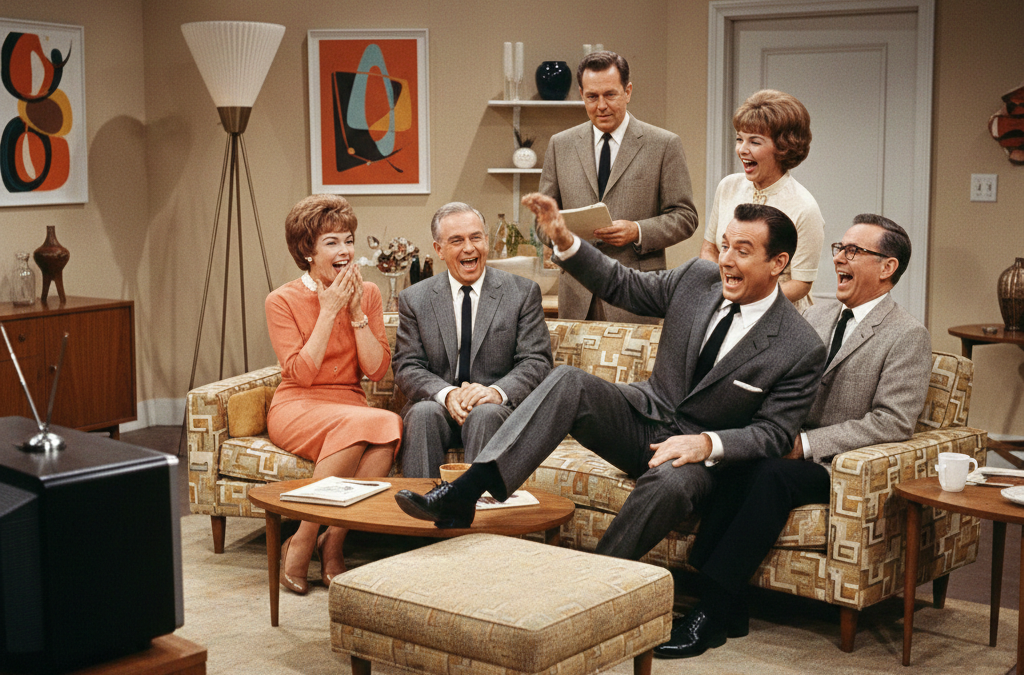
The Dick Van Dyke Show, originally airing from October 1961 to June 1966, is the way a romance novel should be—in talking book form with black-and-white moving images, all the crap taken out and great writing slotted in. Quality dialogue, brilliant storylines, and on-screen chemistry with Mary Tyler Moore. Carl Reiner as Alan Brady, along with Richard Deacon (Mel Cooley), Rose Marie (Sally Rogers), Morey Amsterdam (Buddy), Ann Morgan Guilbert (Millie Helper), and Jerry Paris (Jerry Helper)—a core cast to behold.
For the generation growing up in the ’60s and ’70s, familiarity is enveloping comfort: chicken paprikash, the milkman, one-income families, school play costumes made by mum, eating at a nicely set table, washing up and talking, spontaneous invitations, landline and singular TV, and stylish dressing even at home.
We can’t lock anything now. Privacy policies with “ambiguous language” make it impossible for consumers to know what data is being shared or how to opt out. Typically, a privacy policy is almost 7,000 words and takes 29 minutes to read. The only “ambiguous language” in any episode of The Dick Van Dyke Show is shared for laughs and snappy exchanges in less than 29 minutes.
It’s an effortless classic of masterful themes and dialogue between a multi-talented cast. Game-changing, genre-shattering, always punching up and never down. Watching characters with impossibly not impossible lives, conversations, and relationships provides lessons in life and a sense of respect and welcome.
Why We Still Need It
The recent horrors experienced by the Reiner family are impossible to ignore. It’s where it all started—like father, like son. Talented and genuinely humble. The world has crumbled.
The “lipstick index” is a lie, but its psychological equation is true: when people feel they have less than they need, more is spent on small, beautiful things—money, time, thought. Treasures that bring brightness help cut through the suffocating dark.
We need The Dick Van Dyke Show more than ever. Even if you weren’t born when it aired, immerse yourself. Know that the behavior depicted reflects how it was then—respectful, welcoming, and not without conflicts. Holding its social norms to today’s standards misses the point. It’s a helluva show for when the world feels like hell.
One of its most appealing aspects: seeing collaboration and talent shine without knowing their politics or opinions. Characters remain eternally entertaining, relationships complex yet meaningful, and conversations full of lessons.